


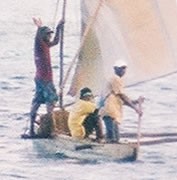

The Maskelyne Islander in Vanuatu are an Indigenous island people of the Maskelyne Islands, a small chain of low islands lying just off the southeastern coast of Malekula in Malampa Province. Reliable outside sources identify the Maskelyne Islands as a distinct archipelago within southern Malekula, with Uluveo as the main inhabited island and several other small islands in the chain. This matters because the Maskelyne Islander are not simply generic southern Malekula villagers; they are a recognizable island community shaped by life on a small offshore archipelago.
For consistency with your new rule, the primary language belongs here: their language is Maskelynes, also called Kuliviu or Uliveo in outside linguistic sources. Reliable sources identify it as an Oceanic language within the Austronesian family, spoken specifically on the Maskelyne Islands off south Malekula. Ethnologue further notes that it remains the normal language of home and community life among the ethnic group, which is useful because it confirms that this is still a living ethnolinguistic community rather than merely a historic label.
Historically, the Maskelyne Islander in Vanuatu should be understood within the wider world of small-scale Melanesian island communities, where identity is deeply tied to land, sea, kinship, and village belonging. Outside sources note that the Maskelyne Islands were historically attractive partly because their offshore position gave some protection from mainland attacks, which likely helped preserve their settlement continuity. In the broader national context, Vanuatu is famous for extraordinary local diversity, with a very high concentration of small language communities across relatively short distances. That larger pattern helps explain why the Maskelyne Islander remain a distinct people rather than simply blending into a broader "Malekula" identity.
The Maskelyne Islander in Vanuatu live in a small-island maritime environment where daily life is closely tied to the sea, the reef, and nearby mainland garden areas. Reliable outside sources describe the Maskelyne Islands as remote, with limited infrastructure, simple village conditions, and strong dependence on local resources. One UNESCO source specifically mentions a sailing canoe returning from food gardens on the mainland, which is an unusually valuable detail because it shows a practical pattern of life: the islands themselves are important home communities, but food production is also linked to mainland access.
Their economy and food supply are shaped by fishing, reef resources, and garden agriculture. Outside sources note that the waters around the Maskelynes are rich in fish and marine life, and even informal local reporting consistently highlights fresh sea produce as central to life there. In a place like this, fishing is not a side activity; it is part of the ordinary rhythm of provision, transport, and family life. The combination of marine harvest and mainland or nearby garden access fits the classic pattern of many small offshore Melanesian communities.
Because Vanuatu is so linguistically diverse, wider communication beyond the islands likely often involves Bislama, while village life remains anchored in the local community. That broader national reality is well established, though this profile should not overstate undocumented bilingual patterns for this specific people. What can be said carefully is that the Maskelyne Islander live in a setting where local identity is strong, village life is relational and close-knit, and outside services may be limited by geography and transport. Small schools and health facilities do exist, but outside sources indicate infrastructure remains modest by national and regional standards.
The Maskelyne Islander in Vanuatu are traditionally identified as Christian. Per your rule, this section is based strictly on the internal source. The internal profile indicates that Christianity is the dominant religious identity among them, with a smaller minority still connected to ethnic religious beliefs. That means it would be careless to assume that outward Christian affiliation automatically equals saving faith. In a people like this, church identity and Christian vocabulary may be common, yet some families may still carry older spiritual assumptions, customary fears, or only a shallow attachment to biblical truth.
That should not be romanticized. Where Christian identity is widespread but spiritual depth is uneven, the need is not simply more religious familiarity, but true repentance, personal faith in Jesus Christ, and a life submitted to the authority of Scripture. If older spiritual habits or inherited assumptions remain beneath outward profession, the need is for clear biblical teaching, genuine conversion, and strong discipleship so that faith in Christ is living, obedient, and free from mixture.
The Maskelyne Islander in Vanuatu need strong biblical discipleship in a setting where Christian identity is already familiar. Their greatest need may not be first exposure to the name of Jesus, but the transforming work of the Holy Spirit that brings conviction of sin, true repentance, and joyful obedience to Christ. They need pastors, elders, and faithful believers who can clearly teach the Word of God and help people move beyond nominal Christianity or inherited religion into genuine, enduring faith.
They also need strong local churches and mature local leaders. Because they are a small island people with a localized identity across a remote archipelago, durable ministry must be rooted in family life, trusted relationships, and clear teaching that is understandable within the community. Fathers, mothers, grandparents, and younger believers need to see that following Christ is more than belonging to a Christian-identified island community. They need homes where Scripture is honored, sin is confronted, forgiveness is practiced, and Christ is openly confessed.
Practical realities matter as well. In a remote island setting like the Maskelynes, transportation, access to medical care, education, and stable daily provision can all affect family life and the consistency of church fellowship. Outside sources indicate the islands remain remote and have limited infrastructure, even though some local schools and health support exist. Geographic isolation, weather, and dependence on sea travel can make leadership training, pastoral support, and regular ministry harder to sustain.
Pray that the Maskelyne Islander in Vanuatu would move beyond outward or inherited Christian identity and come to true repentance, living faith, and joyful obedience to Jesus Christ.
Pray for pastors, elders, and faithful disciplers to teach God's Word clearly among the Maskelyne Islander with humility, biblical conviction, and deep love for the people.
Pray for believers among the Maskelyne Islander in Vanuatu to reject shallow religion, spiritual mixture, and mere tradition, and to stand firmly on Scripture alone.
Pray for fathers, mothers, grandparents, and young people to be strengthened in family life, so that homes become places where Christ is honored and truth is passed on faithfully.
Pray for practical help where needed in transportation, education, medical care, and daily provision, and pray that strong local churches would grow in maturity and faithfulness across the Maskelyne Islands.
Scripture Prayers for the Maskelyne Islander in Vanuatu.
https://en.wikipedia.org/wiki/Maskelyne_Islands
https://en.wikipedia.org/wiki/Uluveo
https://en.wikipedia.org/wiki/Maskelynes_language
https://www.ethnologue.com/language/klv/
https://www.omniglot.com/writing/maskelynes.htm
https://unesdoc.unesco.org/ark:/48223/pf0000180705
| Profile Source: Joshua Project |


